The 2025 Giving Divide: What the Latest Blackbaud Data Means for Your Digital Strategy
If you felt like 2025 was a rollercoaster year for fundraising, well, you had company on that ride.
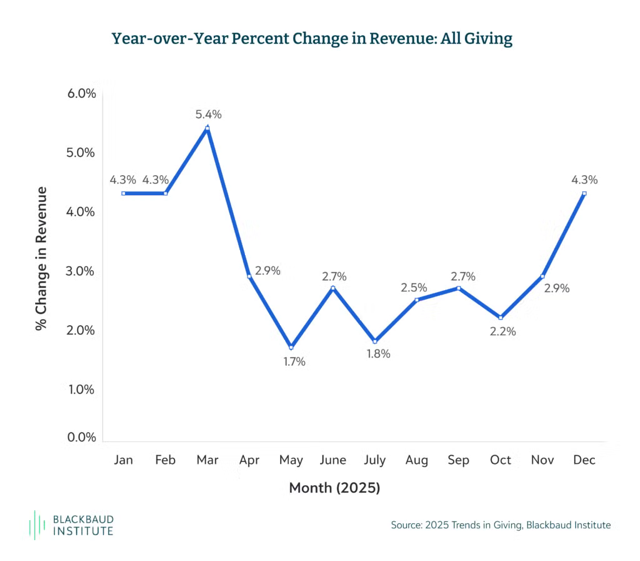
The Blackbaud Institute just released its 2025 Trends in Giving report, analyzing data from over 7,500 nonprofits totaling $66 billion in revenue. On the surface, the headline looks great: the median nonprofit grew by about 4.3% year-over-year. But when you dig into the numbers, a much more complicated story emerges. That growth wasn't shared evenly. In fact, a massive divide has opened up in the sector.
Large organizations saw revenue jump by 11.7%, while small nonprofits (under $1M in revenue) actually saw a 6.4% decline.
Why is this happening, and more importantly, how can your nonprofit adapt its digital strategy to close the gap?
Here are the four biggest takeaways from the 2025 data and how you can turn them into action.
1. The Tale of Two Donors: Major Gifts vs. Broad-Base Giving
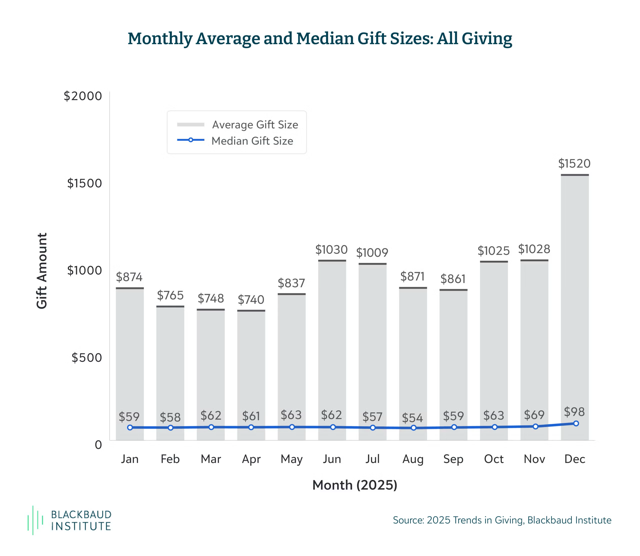
The single biggest driver of the 2025 divide comes down to gift size. According to the report, revenue from mid-level and major gifts ($1,000+) grew by 4.7%. Meanwhile, low-level giving (under $1,000) dropped by 1.1%.
Large organizations naturally have more resources to court major donors, which insulates them from dips in everyday consumer spending. Smaller organizations, which rely heavily on mass donations, felt the pinch.
You can't afford to lose your broad-base donors, but you can make it easier for them to give. It’s time to obsess over friction.
Optimize for Recurring Giving: Turn that shrinking pool of one-time small donors into reliable monthly sustainers. Make "Monthly" an easy option for your donors to default to on your digital donation forms. If they opt for one-time, segment your email follow-up, so you can ask one-time donors to become recurring givers. Even if they decline, use this segment to build a relationship over time to convert them to recurring donors.
Identify the "Missing Middle": Use your email marketing sequences and CRM data to identify small donors who have the capacity to upgrade. Targeted, automated email nurtures can seamlessly transition a $100/year donor into a mid-level supporter without draining your staff's time.
2. Q4 is Still Top Dog (But You Have to Earn It Early)
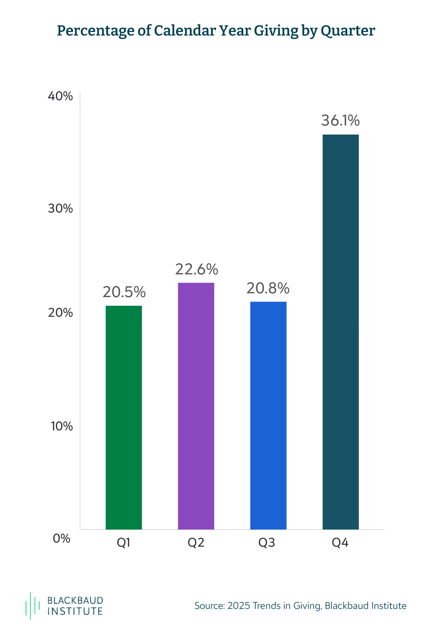
Even in a year where economic growth cooled in the fourth quarter, charitable giving didn't flinch. A staggering 36.1% of all annual revenue arrived in Q4, with December alone accounting for 18% of the year's total giving.
However, the organizations that won Q4 didn't start planning in November. They laid the groundwork all year long.
If you are relying solely on organic social media in December, your message is going to get buried. And if you wait until the holidays to launch a brand-new paid campaign, you will be paying a premium to compete in the most crowded digital market of the year.
Leverage the Google Ad Grant: If your Google Ad Grant is optimized properly, you should be capturing high-intent search traffic ("ways to give back in Arlington," "tax-deductible donations 2026") right when donors are looking to make end-of-year contributions.
Retargeting: Use paid social and display ads in Q3 and Q4 to retarget people who visited your site earlier in the year. Familiarity builds trust, and trust drives donations. Not ready to ask for a gift? Try a ‘Thank You’ ad campaign that retargets your existing donors with a simple, genuine note of thanks.
3. Digital Giving is Outpacing Overall Growth
While overall giving grew by roughly 4.3%, online giving grew by a massive 11% YoY, peaking in November. The median online gift size hit $364 in December.
Donors are becoming more comfortable making larger gifts directly through digital portals. But if your website is slow, hard to navigate on a phone, or drops visitors onto a generic homepage instead of a specific landing page, they will bounce.
Your digital presence needs to match the professionalism of your mission.
Audit your landing pages: Does the page a donor lands on directly answer the question they searched for? Does it load instantly—and across mobile and laptop/desktop browsers? Are your CTAs clear and easy to act on?
Trust Signals: Ensure your pages feature strong E-E-A-T (Experience, Expertise, Authoritativeness, and Trustworthiness). Real staff photos, clear financial transparency, and specific impact metrics and stories help a donor feel safe making a $300+ digital transaction. (Tip: Once you publish your upcoming blog post on SEO and Answer Engines, you can hyperlink the E-E-A-T mention directly to it!)
4. Corporate Giving: The Hidden Pathway
One of the most interesting tips hidden in the report is the rising importance of corporate giving and employee matching, particularly for younger generations. In workplaces that offer these programs, nearly 90% of Gen Z employees participate.
Make employer matching incredibly obvious. Integrate employer matching lookup tools directly into your donation forms. In your post-donation automated "Thank You" emails, always include a quick prompt asking the donor to check if their company matches gifts. It is one of the lowest-lift ways to double a contribution.
The Bottom Line
The 2025 data proves that the organizations leaning into strategic, targeted growth are pulling ahead, while those relying on "business as usual" are falling behind.
You don't need a massive team to run a large-scale strategy. By automating your email nurtures, optimizing your landing pages, and letting tools like the Google Ad Grant and smart email marketing do the heavy lifting for donor acquisition, your organization can punch well above its weight class.
👉 Learn more about the report, the methodology, and the data.
Need help turning these trends into a digital strategy? Whether you need an Ad Grant audit, a paid search campaign, or a complete digital overhaul, the team at Good Dog Strategies acts as an extension of your nonprofit. Contact us today to schedule a free digital strategy consultation.